HIDROGRAPHY
At Combapata (3,400 m.a.s.l.), the Vilcanota and Salca rivers meet, continue on as Vilcanota and later change names again, to become the Urubamba. When the two rivers meet at Combapata, the Vilcanota has already run 70 kms. from its source on the slopes of Mt. Vilcanota and carries 10-15 m3/s of water. The Salca River has come some 90 kms. from Lake Sabinacocha, which is fed by waters from Mt. Jatunnano Punta, and its water volume is 20-25m3/s. After Combapata, the river is navigable all year long, except for February and March when the water level is highest.
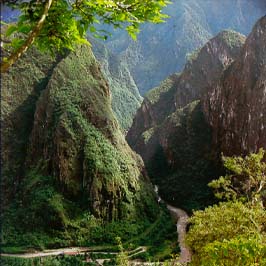
The slope of the river is about 12m./km. for the Salca River between Sabinacocha and Combapata, with a peak of 24m./km. at Santa Barbara. Then, from Combapata to Ollantaytambo, the drop-off is not more than 4m./km. The slope increases again between Ollantaytambo (2,700 m.a.s.l.) and Machu Picchu at an average of 16m./km. and again between Machu Picchu and Quillabamba (950 m.a.s.l.) where it reaches an average of 25m./km. with peaks of 32m./km. at Santa Teresa (1,600 m.a.s.l.). The slope tapers off between Quillabamba and Echarate to an average of 5m./km. Below Echarate (750 m.a.s.l.) the Urubamba becomes an increasingly tranquil tropical river.
© CanoAndes 1981
© Embajada del Viajero S.A. 1981
Lima, Peru